/
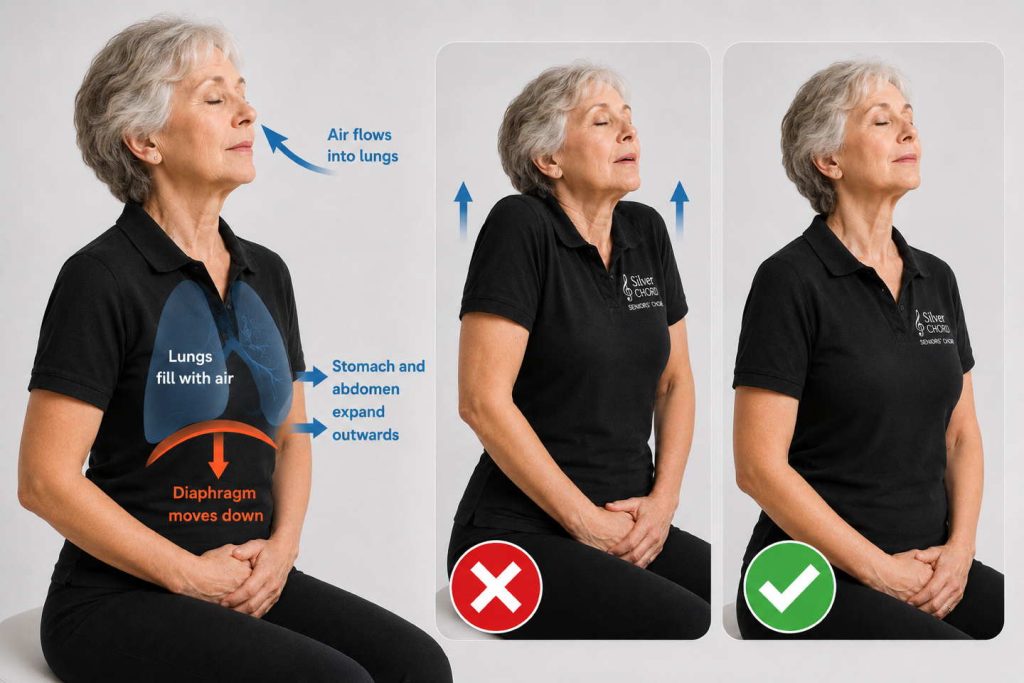 We all know how to breathe – we do it all the time. But when we sing, we have to adapt our normal breathing patterns to give us more control and capacity. This means becoming conscious of exactly what’s going on.
Breathing happens from your diaphragm, not your ribcage. We do NOT breathe by raising and lowering our shoulders; while they may pull up on the ribcage, they don’t expand it. Watch a professional singer; they don’t move their shoulders!
Breathing comes from the diaphragm, the muscle below the lungs. As you breathe in, think of your diaphragm dropping and the air flowing into your lungs. Let your stomach and your abdomen move outwards naturally; it’s okay.
If you must use your ribcage, think of it only as a reserve tank. It is in fact called “rib reserve”, and it should be used only if you know there’s going to be a sustained passage. Even then, think about your ribcage expanding, not your shoulders rising. Use your diaphragm breath first, then the rib reserve if you need it.
Stand or sit up straight (more on posture in another tip) so the air has a clean drop into your lungs. It can then also flow more easily out through your mouth.
Credit for the following tips goes to musicnotes.com, who are a great source of information as well as one of the largest publishers of downloadable sheet music in the world.
We all know how to breathe – we do it all the time. But when we sing, we have to adapt our normal breathing patterns to give us more control and capacity. This means becoming conscious of exactly what’s going on.
Breathing happens from your diaphragm, not your ribcage. We do NOT breathe by raising and lowering our shoulders; while they may pull up on the ribcage, they don’t expand it. Watch a professional singer; they don’t move their shoulders!
Breathing comes from the diaphragm, the muscle below the lungs. As you breathe in, think of your diaphragm dropping and the air flowing into your lungs. Let your stomach and your abdomen move outwards naturally; it’s okay.
If you must use your ribcage, think of it only as a reserve tank. It is in fact called “rib reserve”, and it should be used only if you know there’s going to be a sustained passage. Even then, think about your ribcage expanding, not your shoulders rising. Use your diaphragm breath first, then the rib reserve if you need it.
Stand or sit up straight (more on posture in another tip) so the air has a clean drop into your lungs. It can then also flow more easily out through your mouth.
Credit for the following tips goes to musicnotes.com, who are a great source of information as well as one of the largest publishers of downloadable sheet music in the world.
Exhale on a Hiss
A widespread (and very impactful) breathing exercise is one in which you will inhale for a specified amount of time, and then exhale on a hiss or “sss” sound. Find a metronome, or download a metronome app, and set it to 80 bpm in 4/4 time. Next, practice different amounts of time inhaling an exhaling. Remember that as you inhale, you should be breathing from your diaphragm, not your neck and shoulders. You can use this chart as a guide to get yourself started:| Inhale | Exhale “sss” |
| 4 Counts 4 Counts 4 Counts 4 Counts 2 Counts 2 Counts 2 Counts 2 Counts 1 Count 1 Count 1 Count 1 Count | 4 Counts 8 Counts 12 Counts 16 Counts 4 Counts 8 Counts 12 Counts 16 Counts 4 Counts 8 Counts 12 Counts 16 Counts |
The diaphragm is a dome-shaped, muscular and membranous structure that separates the chest and abdominal cavities in mammals; it is the principal muscle of respiration.
The Straw Technique
Another excellent breathing exercise is exhaling or humming a tune through a straw. When your breath is concentrated through the straw, you are solely focusing on breath support since your face and body will be remaining still. You can follow the same format as the “hiss” exercise, or you can hum the song(s) you are working on through the straw. You can inhale through the straw, or you can inhale outside of the straw if you feel lightheaded. Next, use your exhaled breath to carry your hum through the straw. Try and hum an entire song–it’s harder than it looks! Make sure you are not biting down on the straw, but gently placing it between your lips so that all of the air you exhale is exiting through the straw.Lay on Your Back
Laying on your back is another useful breathing exercise because it forces you to breathe with your diaphragm. Try singing through one of your voice pieces while you are laying on your back and place your hands on your stomach. Each time you inhale, you should feel your stomach expand, and your diaphragm move down. As you exhale, your diaphragm should move up and your stomach should flatten.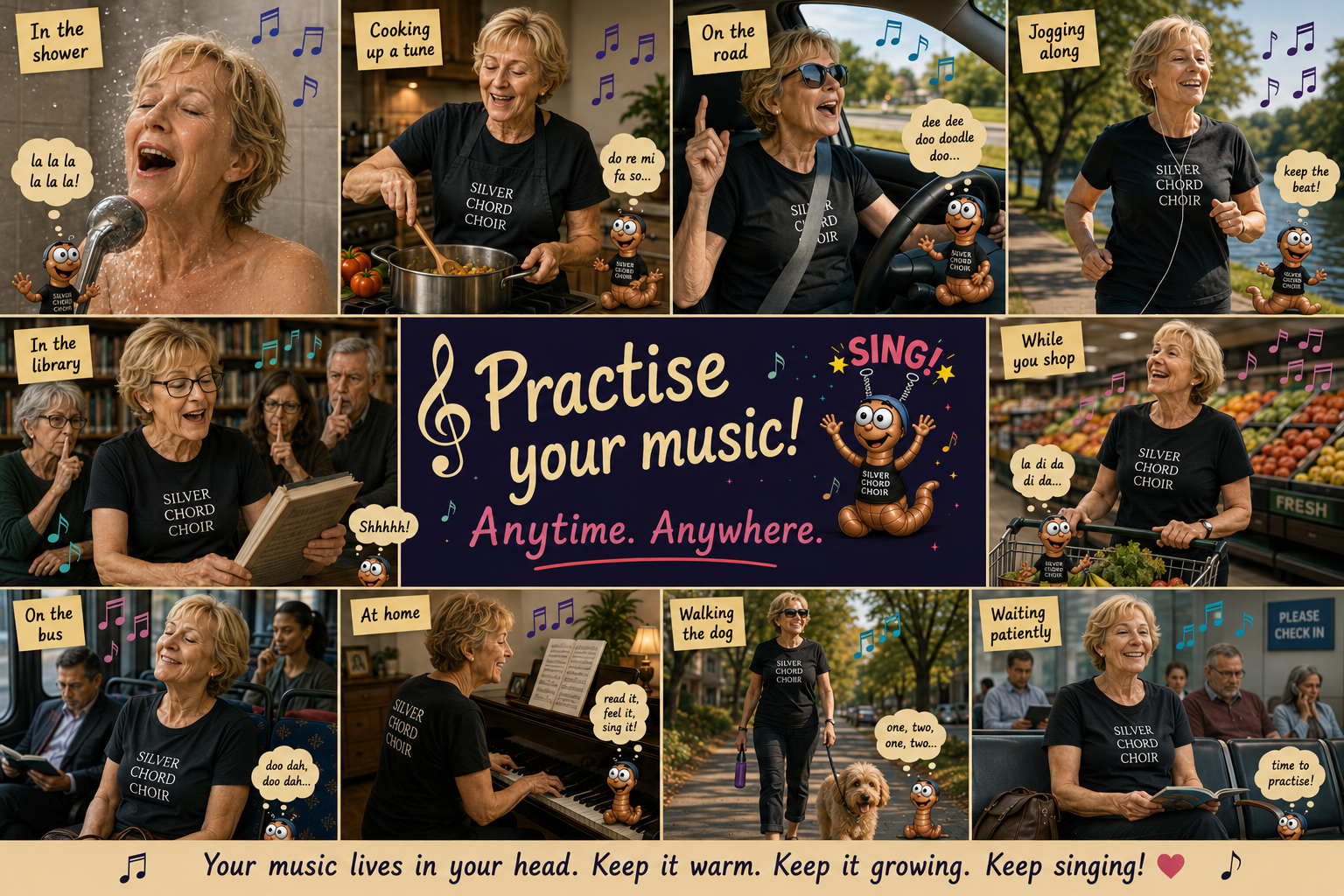
Learning and practising go hand in hand. Practice is something you do all the time, not just at rehearsals.
Sing a song over and over in the shower, in the car, to yourself on the bus – wherever you can.
Practise singing without the words in front of you – the shower and the car are good places to enforce this! Learn a verse at a time. Once you know it, move on to the next – don’t waste time repeating the parts you already know.
If you have a portable recorder or if you know how to record on your phone, record the song during rehearsals, then practise at home with it.
When you come to rehearsal, you should have a good grip on the song and be ready to polish it with the rest of the group.
 It is a sad fact that most of us are lazy singers and creatures of habit. Many of us are also scared of the sound of our own voice. But voice is really what choral singing is all about.
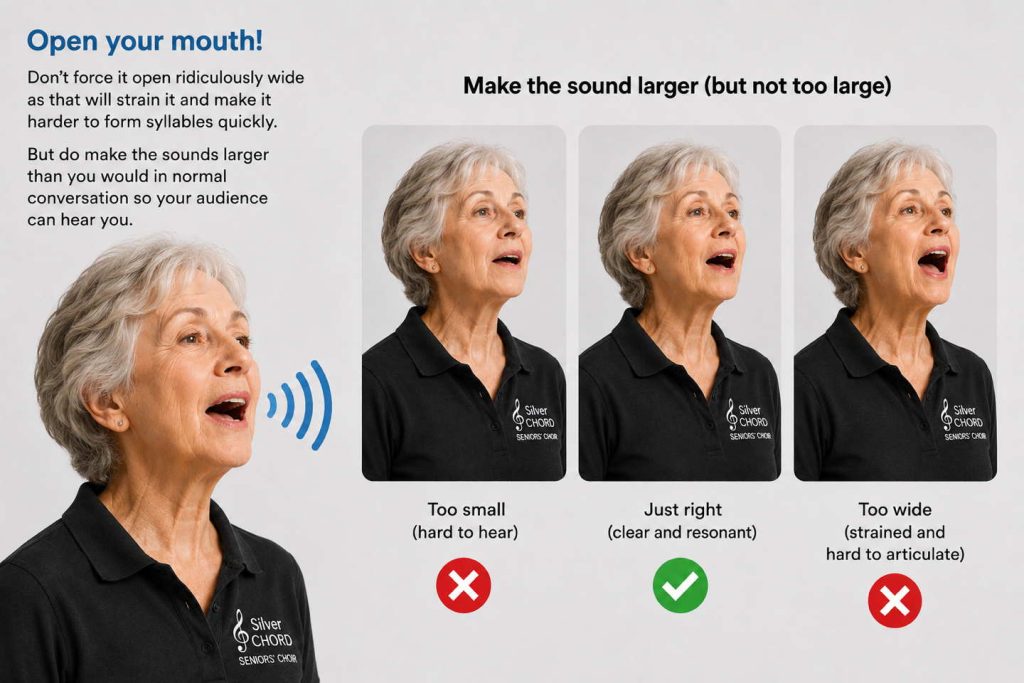
Your voice should come from your open mouth. This implies a couple of obvious things:
Open your mouth! Don’t force it open ridiculously wide as that will strain it and make it harder to form syllables quickly. But do make the sounds larger than you would in normal conversation so your audience can hear you.
Sing your vowels — AH, EH, EE, OH, OO and repeat, exaggerating the size a little each time until it starts to feel forced.
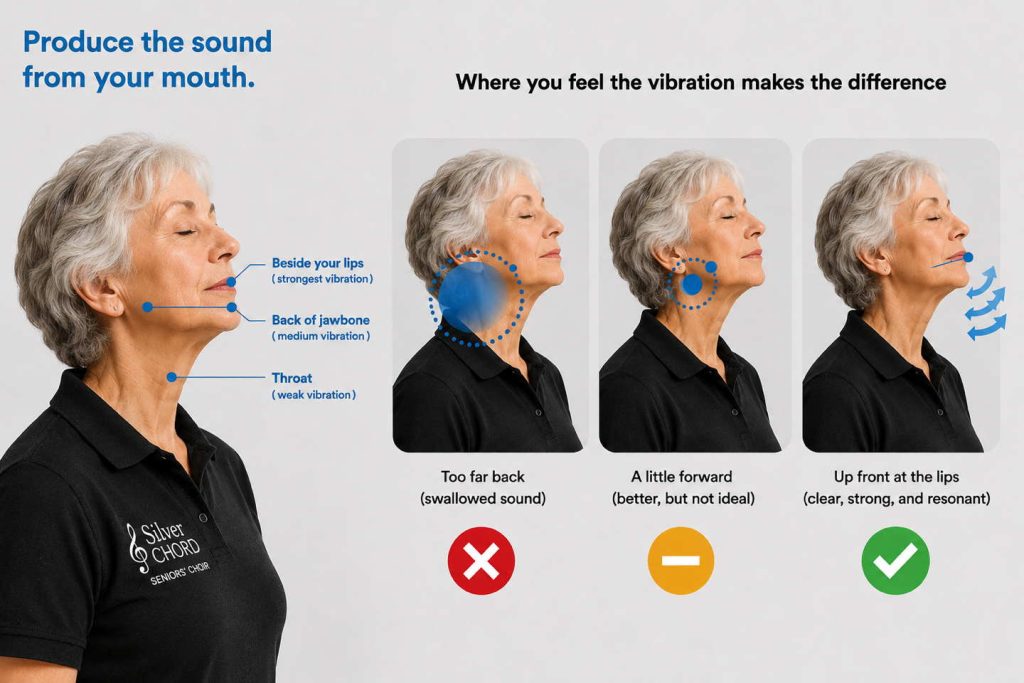 Produce the sound from your mouth. This means getting the sound production up front, out of your chest and your throat — and definitely out from behind your nose! Try humming a sustained, comfortable note. Feel your throat, then further up at the back of your jawbone and finally right beside your lips. You should feel the strongest vibration at the lips. If it’s anywhere further back, you’re swallowing your voice and it gets muffled and dull.
Buzz your lips. Feel where the energy’s going from? Now open your mouth without letting the sound drift back. Sing a simple song – “Mary Had a Little Lamb” will do – while focusing on keeping the sound at the front of your mouth. With practice your voice will get brighter and you’ll waste less energy trying to push the sound out.
The shower is a great place to practice!