
Your voice is a muscle. As with any exercise, you must warm it up. This can take many forms, most of which you can do on your way to a rehearsal or a performance.
Credit for several of the following tips goes to musicnotes.com, who are a great source of information as well as one of the largest publishers of downloadable sheet music in the world.

 Pitch Practice
- Arpeggios
Arpeggios
Arpeggios are not only effective as a vocal exercise but as an ear training exercise as well! The quicker you sing arpeggios, the more difficult it gets to hit the center of each pitch. As you sing, really focus on moving from one pitch to another with precision. You can sing arpeggios on a vowel sound such as “ah” or “oh,” “solfège,” or, you can add a phrase with the same number of syllables as there are notes. For example, try: “Mighty fine weather today.”

 Arpeggios - High.mp3
- Arpeggios - Low.mp3
- Arpeggios major-minor
Arpeggiate Alternating Major and Minor Triads
This exercise is definitely more difficult being that it’s an ear training exercise as well an intonation exercise. Start by arpeggiating a major triad, go up a half step, and then arpeggiate a minor triad, go up a half step, and repeat the process. You can do this on any vowel sound, solfège, or phrase.
- Arpeggios - Alternating Major-Minor.mp3
- Humming
Humming
One of the gentlest ways to start warming your voice up is with a hum. We recommend starting with some major pentascales and going up by a half step as high as you comfortably can.
Repeat the process, this time going down by a half step as low as comfortably possible.
 You can also hum minor pentascales, arpeggios, octaves, etc. Just hum until your vocal
cords start to feel warm and ready!
You can also hum minor pentascales, arpeggios, octaves, etc. Just hum until your vocal
cords start to feel warm and ready!
- High Voices
- Major Pentascales Ascending High.mp3
- Major Pentascales Descending High.mp3
- Low Voices
- Major Pentascales Ascending Low.mp3
- Major Pentascales Descending Low.mp3
- Do-Re-Mi
Do-Re-Mi
This is the beloved song from The Sound of Music. Julie Andrews subtly teaches her entourage the note names in the Tonic Solfège in a playful, catchy song. Silver Chord has used this as our de facto warmup for years. There's the short version we sing and a long version from the movie.- Do Re Mi Words
- Vowels
Vowels
Warming up by singing through your vowels is a great way to focus your tone and energy before you start singing through your repertoire. Sometimes when we are tired or distracted, our tone can close up without us recognizing it, so taking a few moments to consciously focus your tone will result in a much more efficient practice. You can start on any note and move up or down by a half step as you go. Sing through the vowels “ae-ee-ah-oh-oo” and do your best to connect each vowel, not breathing until you move up to the next note.
- Breath Control
- Ha-ha-ha
HA-HA-HA (Great for chest voice)
This exercise is a lot of fun! It's perfect for singers looking to strengthen their chest voice or increase their chest voice range. It’s simple – all you have to do is sing a good, firm “ha” on each note of a descending pentascale. The trick is to allow for space between each note so that your emphasis is strong on each
pitch. Think of these notes as staccato as well as accented.
Sing these notes in your chest voice and push yourself to increase your range each time!
The trick is to allow for space between each note so that your emphasis is strong on each
pitch. Think of these notes as staccato as well as accented.
Sing these notes in your chest voice and push yourself to increase your range each time!
- Ha-Ha-Ha High.mp3
- Ha-Ha-Ha Low.mp3
- Lip Trills
Lip Trills
Take a breath, and send the breath between your lips and let them vibrate. Make sure your lips are relaxed, and you will find yourself doing a lip trill! When it comes to using lip trills for a vocal warm-up, you will want to take it a step further and add pitch to your trill, so that you are essentially “singing” via lip trills. Lip trills are very beneficial as a vocal warm-up for several reasons:- They help relax your lips so that you can deliver clearer diction and vowel sounds
- They take the pressure off of your vocal cords during warm-up
- They warm up your diaphragm and its surrounding muscles for better breath control and support
- Sirens
Sirens
Sirens, or “octave slides,” sound exactly like what their name suggests: sirens. To break it down, a siren means sliding on an “oh” or “oo” from your lowest comfortable note all the way up to your highest comfortable note, and back down again. This exercise can seem obnoxious and silly, but it’s incredibly effective. Sirens warm up the very highest and lowest parts of your registers while also connecting these registers. If you struggle with a smooth transition from your chest voice to your head voice, this is an excellent exercise for you!
- AH-EH-EE-OH-OO-YOW
AH-EH-EE-OH-OO-YOW
Repeat each syllable nice and long on the same note. Make the final YOW an octave higher and give it a bit of a punch. Make sure you hit that high note dead on. Repeat with the next note up the scale. Make very sure your sound is coming from the front of your mouth - vowels like this are the easiest sounds to lose in the back of your throat.
- Vocal Agility
- Red-leather-yellow-leather
Red-leather-yellow-leather
Say this many times, making sure that each syllable is distinct. Now speed it up gradually as fast as you can. These sounds all come from the front of your mouth and enforce good vocal placement.
- The-lips-the-teeth-the-tip-of-the-tongue
The-lips-the-teeth-the-tip-of-the-tongue
Say this fast a few times to get your lips warmed up and ready to go. It's also a good reminder about where your sound is to come from!
- Solfège Ladders
Solfège Ladders
Solfège ladders are a lot of fun! You will start at do; then you will sing do-re-do, then do-re-mi-re-do, and so on, until you get to the next octave! Here is what it looks like all together: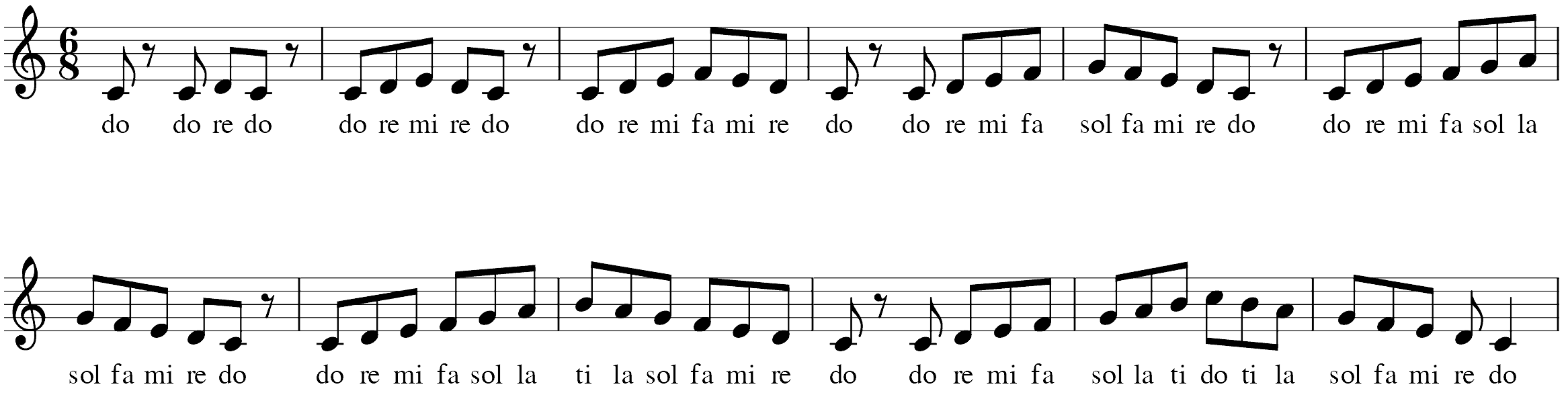 This exercise causes you to focus on pitch and syllables at the same time, so it’s a great way to fire up your brain when you’re working on memorization. Start slow and work on increasing your speed.
Solfège ladders are also a lot of fun to sing in a round! Have one person start the exercise, and when they reach measure 3, have the next person start from the beginning. You can do this with as many people as you want! The more you have, the more difficult it is to hold your part!
This exercise causes you to focus on pitch and syllables at the same time, so it’s a great way to fire up your brain when you’re working on memorization. Start slow and work on increasing your speed.
Solfège ladders are also a lot of fun to sing in a round! Have one person start the exercise, and when they reach measure 3, have the next person start from the beginning. You can do this with as many people as you want! The more you have, the more difficult it is to hold your part!- Solfege Ladders High.mp3
- Solfege Ladders Low.mp3
- MEE-MAA-MEE-MAY-MEE-MO-MEE-MOO
MEE-MAA-MEE-MAY-MEE-MO-MEE-MOO
Sing this quickly all on one note, then go up a note. Change to LEE-LAA etc., then to TEE-TAA etc., or any other letter. Watch your voice placement!
- Tongue twisters
Tongue twisters
Even though they're usually spoken, many "tongue twisters" are great for developing diction and vocal agility. Start by saying each of these slowly but accurately three times. Then repeat faster and faster.She sells seashells by the seashore. The shells she sells are seashells, I'm sure.
Peter Piper picked a peck of pickled peppers. A peck of pickled peppers Peter Piper picked.
How much wood would a woodchuck chuck if a woodchuck could chuck wood?
Betty Botter bought some butter, but she said the butter's bitter.
Fuzzy Wuzzy was a bear, Fuzzy Wuzzy had no hair. Fuzzy Wuzzy wasn't very fuzzy, was he?
The sixth sick sheik's sixth sheep's sick.
Pad kid poured curd pulled cod.
Fred fed Ted bread, and Ted fed Fred bread
Unique New York. Unique New York.
A big black bug bit a big black bear.
- The Little Book of Choir Warmups
- Three Blind Mice
Three Blind Mice
- but sing it like this:Three blind mice (normal volume)
Three blind mice? (soft, questioning)
See how they run (a little louder)
See how they run (same volume, more agitated)
They all ran after the farmer's wife (full volume - but don't yell!)
She cut off their tails with a carving knife! (full volume)
Did you ever see such a thing in your life (soft, almost a shocked whisper)
As three blind mice! (normal volume)
