Here are some helpful tips to help you improve your singing and the wonderful sound of the Silver Chord Choir.
Click the tips below. Most open up into more tips.
Acknowledgement: Many illustrations were created with the help of ChatGPT and the OpenAI image generator.

 Health and Wellness
Don't worry!
We're not out to convert you into vegan marathon runners and gym junkies! How you maintain your health is entirely up to you. We will point out a few things, though.- Diet
Omnivore? Carnivore? Vegetarian? Pescatarian? Gluten-intolerant? Lactose-intolerant?
That doesn't matter! What you eat is entirely up to you.
BUT -
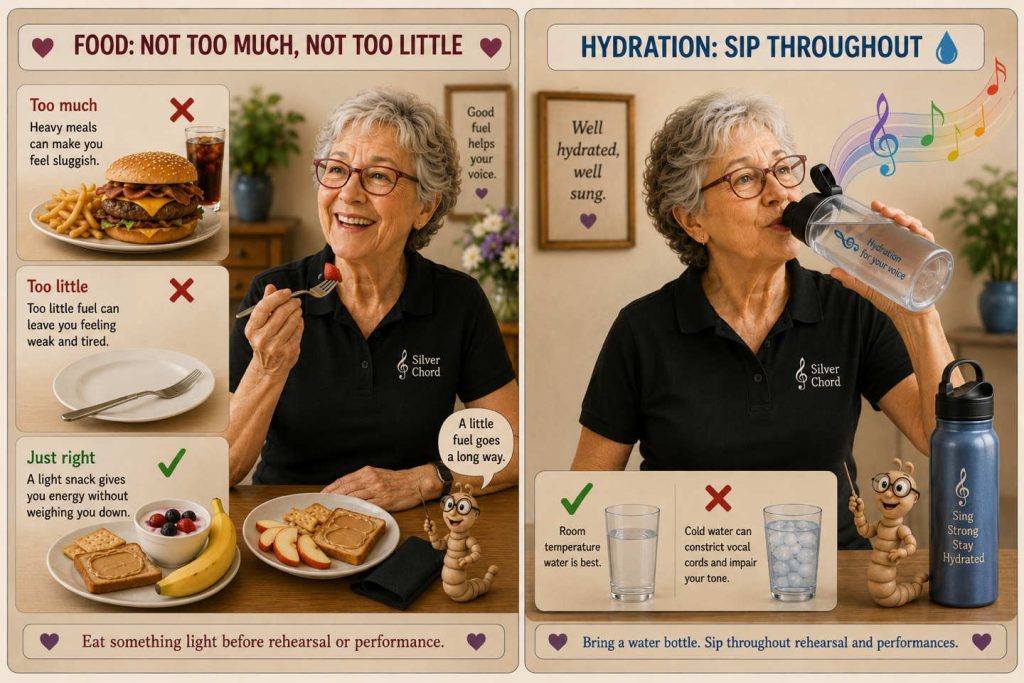
- a full stomach can make you feel sluggish
- an empty stomach can rob you of energy and concentration
- bring water and sip as you need to
- room-temperature water is best. Cold water constricts your vocal chords.
- Exercise and Fitness
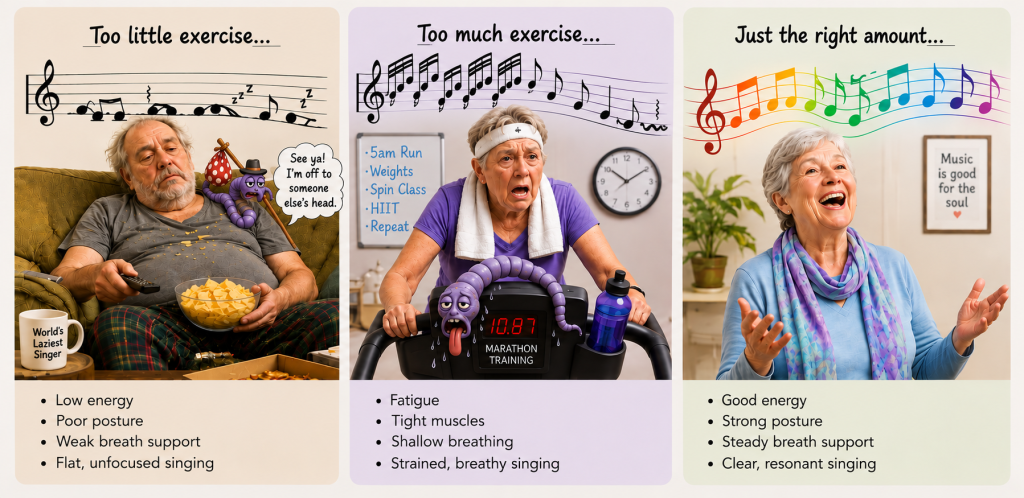
Keep up an appropriate level of exercise and fitness.
Talk to your doctor if you have any questions about a suitable regime.
We'll just point out that the better you feel, the better you'll sing.
Get adequate rest. Just how much you need varies from person to person; just make sure you're awake and alert and able to focus on your singing.
- Know Your Limits
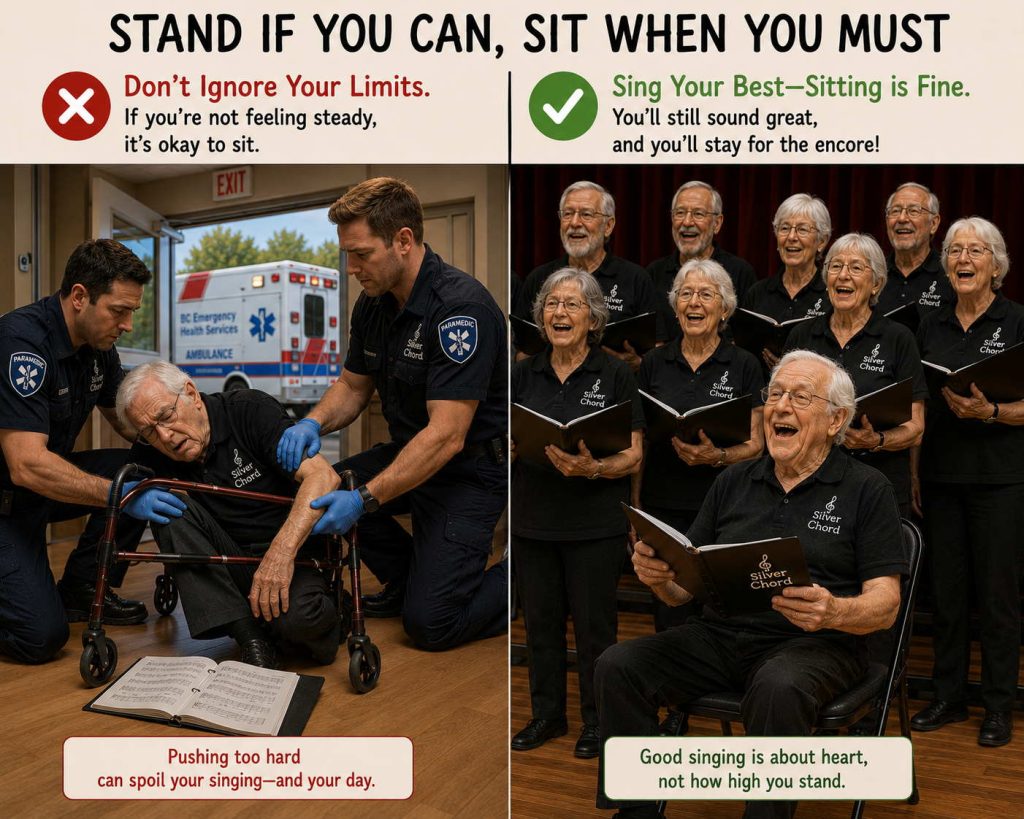
Stay aware of your body. We all have varying abilities. Stand when you can, sit when you must.
Powering through because "the show must go on" is an admirable goal, but if you collapse in the middle of it, the show stops anyway.
- When You're Sick
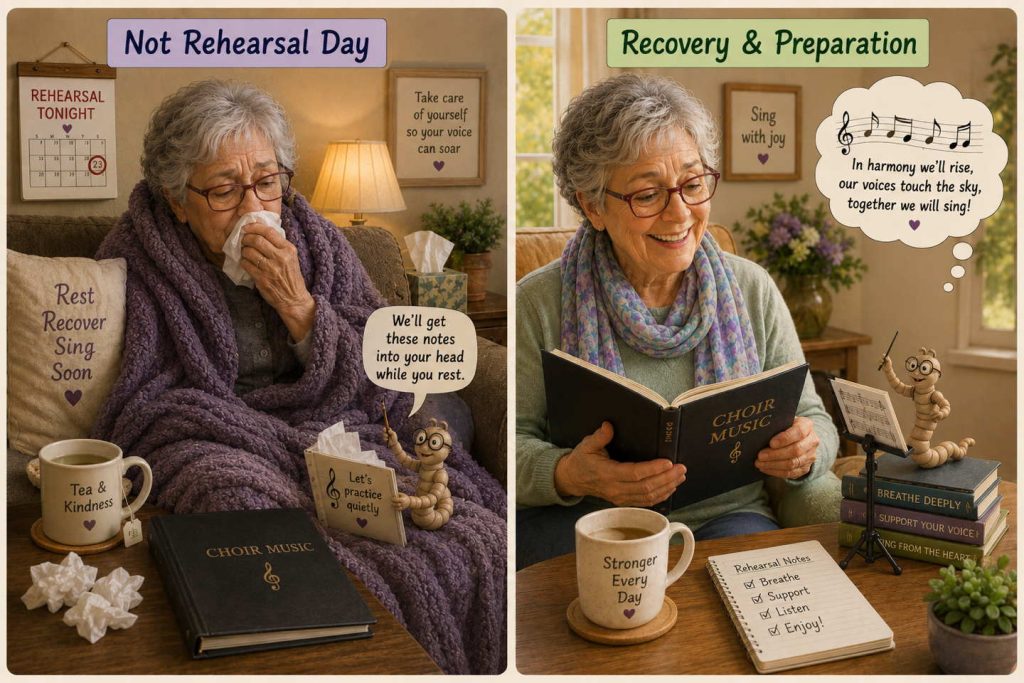
You can't sing well when you're tired or sick. Your concentration and your energy level suffer.
Coming to rehearsal with a bug puts your choir mates at risk.
Stay home, take care of yourself and get well. And while you're recuperating, you can memorise a few songs too, right?
- Breathing
- Breathing
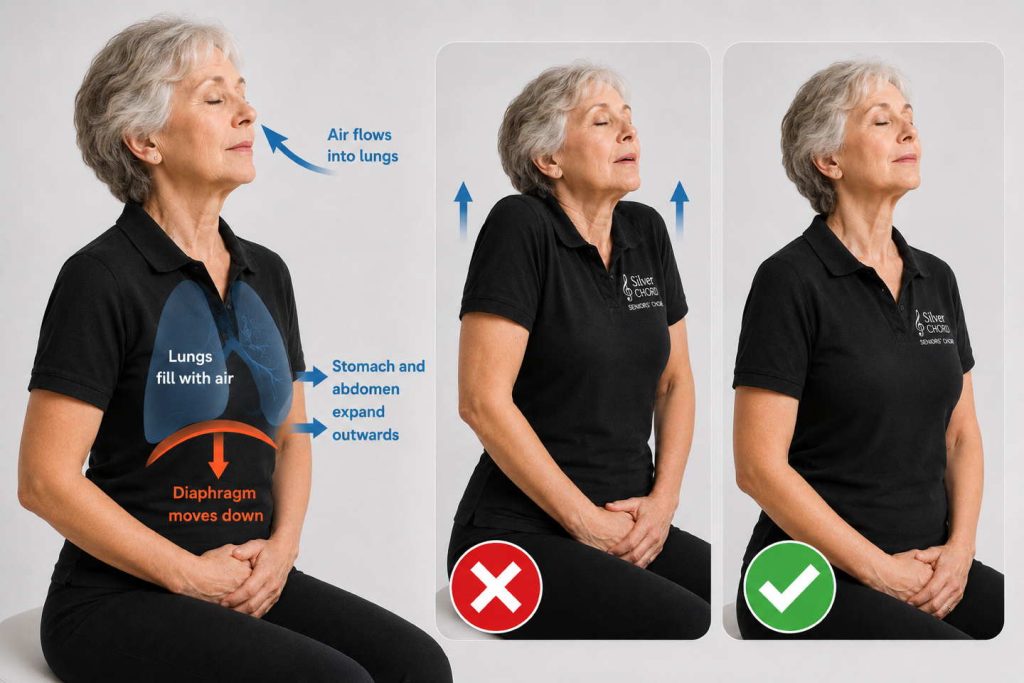
We all know how to breathe - we do it all the time. But when we sing, we have to adapt our normal breathing patterns to give us more control and capacity. This means becoming conscious of exactly what's going on.
Breathing happens from your diaphragm, not your ribcage. We do NOT breathe by raising and lowering our shoulders; while they may pull up on the ribcage, they don't expand it. Watch a professional singer; they don't move their shoulders!
As you breathe in, think of your diaphragm dropping and the air flowing into your lungs. Let your stomach and your abdomen move outwards naturally; it's okay.
If you must use your ribcage, think of it only as a reserve tank. It is in fact called "rib reserve", and it should be used only if you know there's going to be a sustained passage. Even then, think about your ribcage expanding, not your shoulders rising. Use your diaphragm breath first, then the rib reserve if you need it.
Stand or sit up straight (more on posture in another tip) so the air has a clean drop into your lungs. It can then also flow more easily out through your mouth.
Credit for some of the following tips goes to musicnotes.com, who are a great source of information as well as one of the largest publishers of downloadable sheet music in the world.
- Posture
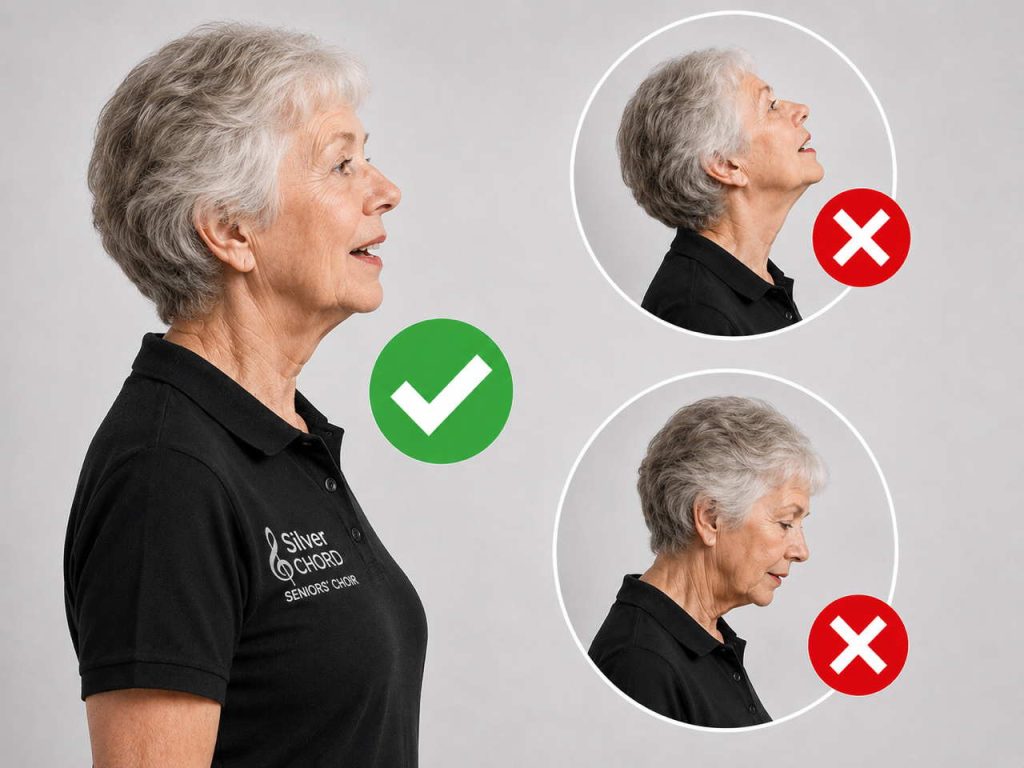
Good posture is all-important for proper singing. It allows for easy movement of your breath in and out of your body. It also aids in effective projection of your voice and makes the choir as a whole look good.
Stand if you're able, or sit up nice and straight. Close your eyes and imagine a string running from the pit of your stomach out through the top of your head. Pull the string taut and feel how your body realigns itself for a clean, clear airflow.
Keep your head up, not buried in your book. This is essential for many reasons: letting your voice out clearly and easily, keeping an eye on your conductor and engaging with your audience.
Check the illustration. For proper posture, there should be roughly a 90 degree angle between the centre line of your body and your mouth.
- Breathing Exercises
- Exhale on a Hiss
Exhale on a Hiss
A widespread (and very impactful) breathing exercise is one in which you will inhale for a specified amount of time, and then exhale on a hiss or “sss” sound. Find a metronome, or download a metronome app, and set it to 80 bpm in 4/4 time. Next, practice different amounts of time inhaling an exhaling. Remember that as you inhale, you should be breathing from your diaphragm, not your neck and shoulders. You can use this chart as a guide to get yourself started:
Challenge yourself with this exercise and time how long you can exhale on a hiss before you run out of breath! Just make sure that you give yourself time in between each inhale so that you don’t get lightheaded.Inhale Exhale “sss” 4 Counts 4 Counts 4 Counts 8 Counts 4 Counts 12 Counts 4 Counts 16 Counts 2 Counts 4 Counts 2 Counts 8 Counts 2 Counts 12 Counts 2 Counts 16 Counts 1 Count 4 Counts 1 Count 8 Counts 1 Count 12 Counts 1 Count 16 Counts The diaphragm is a dome-shaped, muscular and membranous structure that separates the chest and abdominal cavities in mammals; it is the principal muscle of respiration.
- The Straw Technique
The Straw Technique
Another excellent breathing exercise is exhaling or humming a tune through a straw. When your breath is concentrated through the straw, you are solely focusing on breath support since your face and body will be remaining still. You can follow the same format as the “hiss” exercise, or you can hum the song(s) you are working on through the straw. You can inhale through the straw, or you can inhale outside of the straw if you feel lightheaded. Next, use your exhaled breath to carry your hum through the straw. Try and hum an entire song–it’s harder than it looks! Make sure you are not biting down on the straw, but gently placing it between your lips so that all of the air you exhale is exiting through the straw.
- Lay on Your Back
Lay on Your Back
Laying on your back is another useful breathing exercise because it forces you to breathe with your diaphragm. Try singing through one of your voice pieces while you are laying on your back and place your hands on your stomach. Each time you inhale, you should feel your stomach expand, and your diaphragm move down. As you exhale, your diaphragm should move up and your stomach should flatten.
- Voice
- Voice Placement
- Open Your Mouth
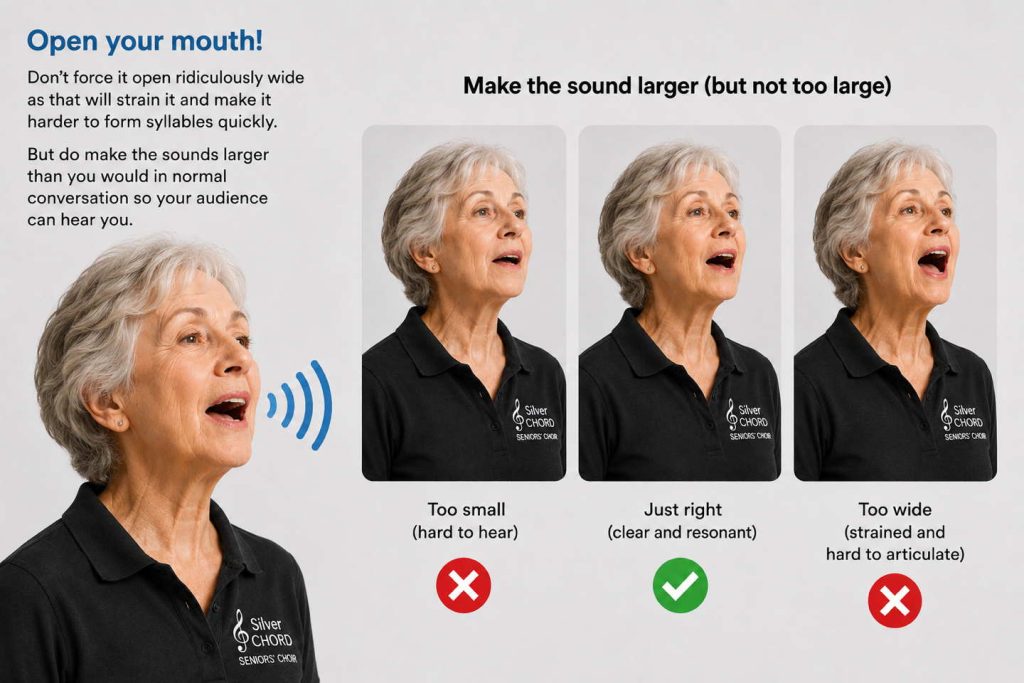
It is a sad fact that most of us are lazy singers and creatures of habit. Many of us are also scared of the sound of our own voice. But voice is really what choral singing is all about.
Your voice should come from your open mouth. This implies a couple of obvious things:
Open your mouth! Don't force it open ridiculously wide as that will strain it and make it harder to form syllables quickly. But do make the sounds larger than you would in normal conversation so your audience can hear you.
Sing your vowels. Sing AH, EH, EE, OH, OO and repeat, exaggerating the size a little each time until it starts to feel forced.
- Sound from Your Mouth
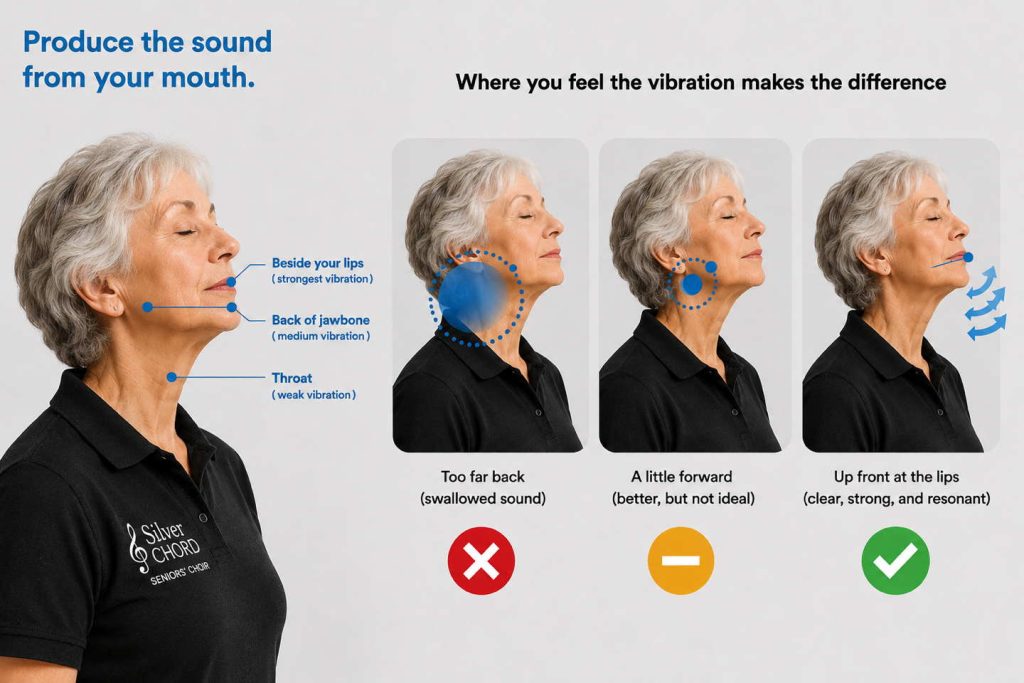
Produce the sound from your mouth. This means getting the sound production up front, out of your chest and your throat — and definitely out from behind your nose!
Try humming a sustained, comfortable note. Feel your throat, then further up at the back of your jawbone and finally right beside your lips. You should feel the strongest vibration at the lips. If it's anywhere further back, you're swallowing your voice and it gets muffled and dull.
Buzz your lips. Feel where the energy's going from? Now open your mouth without letting the sound drift back.
Sing a simple song. "Mary Had a Little Lamb" will do - while focusing on keeping the sound at the front of your mouth. With practice your voice will get brighter and you'll waste less energy trying to push the sound out. The shower is a great place to practise!
- Find Your Range
- Your Range
Your range
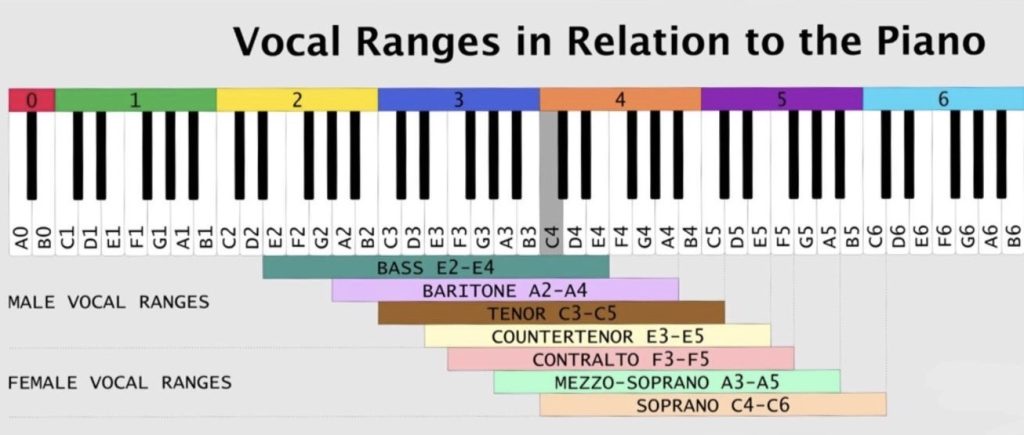 Your range is the highest and lowest notes you can sing comfortably. Most of us have a feel for where we can sing best but may not know what the range is called.
Vocal ranges overlap a lot, as you can see by the chart, yet all ranges span roughly the same number of notes.
Your range is the highest and lowest notes you can sing comfortably. Most of us have a feel for where we can sing best but may not know what the range is called.
Vocal ranges overlap a lot, as you can see by the chart, yet all ranges span roughly the same number of notes.
- Soprano - the highest-pitched range, usually female.
- Mezzo-soprano - many women sing in this range.
- Alto - somewhat lower than soprano. Altos can't usually hit the higher soprano range; conversely, sopranos have trouble with the middle to low alto range. Usually female, but some men can sing a low alto part.
- Tenor - the highest men's range. Few men are true high tenors.
- Baritone - overlaps the bass and tenor ranges. This is the commonest men's range.
- Bass - the lowest common men's range. Few men are true low basses.
- Your Change
Your change
Your voice has a distinct point at which it changes from one tone to another, often towards the top of your range. As you sing a rising scale, you'll feel the change; you make your sound in a slightly different way. Singing across your change takes practice and work, so many singers opt to sing either down or up an octave to avoid it. That can push you out of your range, though, with unpleasant consequences for the sound of the song. The best bet is to practise singing over your change, until you can sing above, below and through it with ease. Try some of the Warmup tips like the Arpeggios, Solfège Ladders or Sirens.
- Smile When You Sing

Smiling changes your whole sound. It relaxes your face and changes the whole shape of your vocal tract. It helps pull your voice up to the front of your mouth. That makes your voice brighter and more distinct so your sound is clearer.
Smiling affects your mood and your outlook! It's hard to feel grumpy when you've got a smile on your face — and that means you'll feel happier when you sing.
A smile is contagious! Your audience will engage much more with a happy, smiling choir who are obviously enjoying themselves.
And yes, smiling even helps sad or serious songs sound better. The smile may not fit the mood of the song but it still makes you sound better.
- Confidence vs. Volume
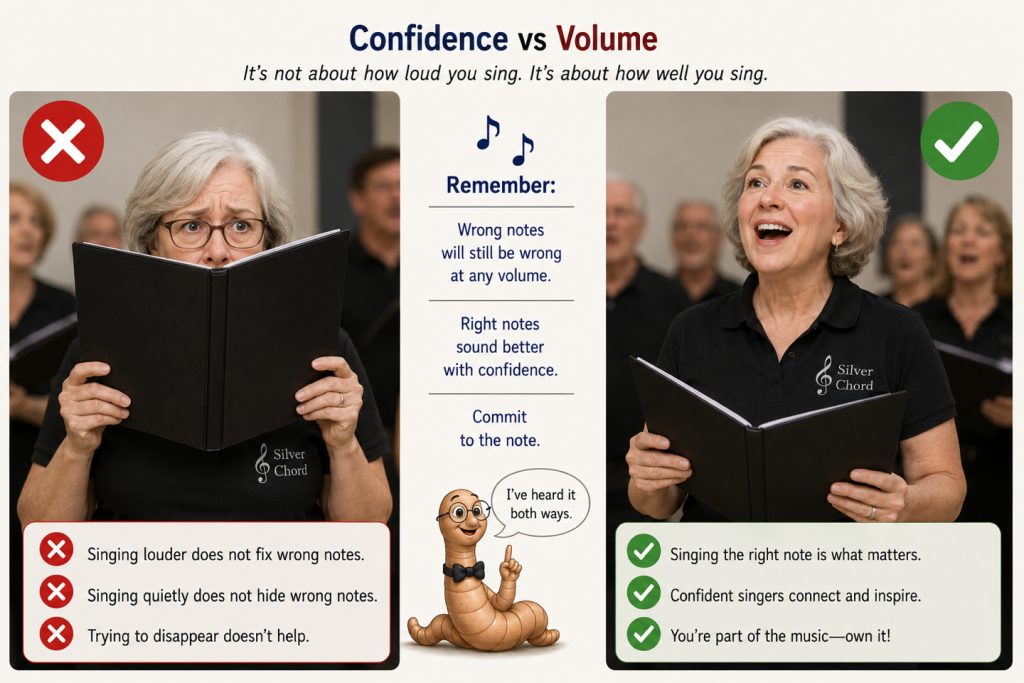
Confidence - NOT Volume — makes you sound better. Volume doesn't fix wrong notes - it highlights them.
Confidence lets you blend with the choir.
- Don't Apologise for Your Voice
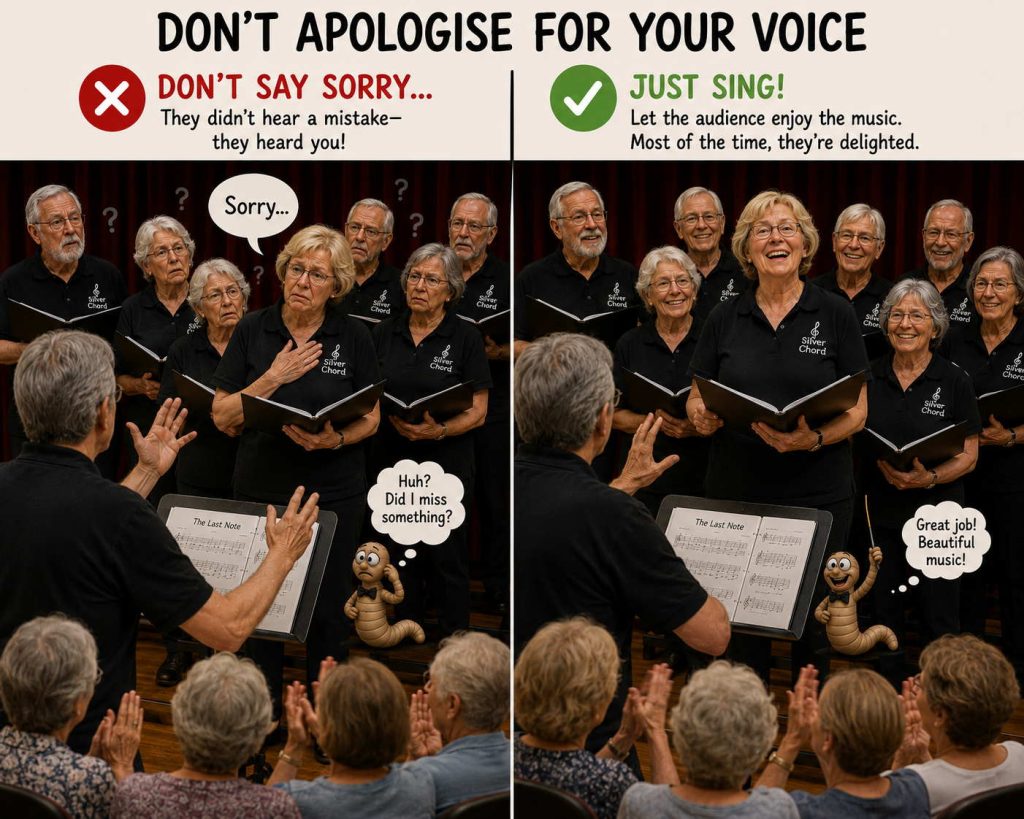
Your voice is your gift to the choir. It helps tell the story in the music. Share it!
If you make a mistake, remember we all do. The audience will never notice it in a show. If it happens in a rehearsal, that's when we can work on it together.
- Support the Melody
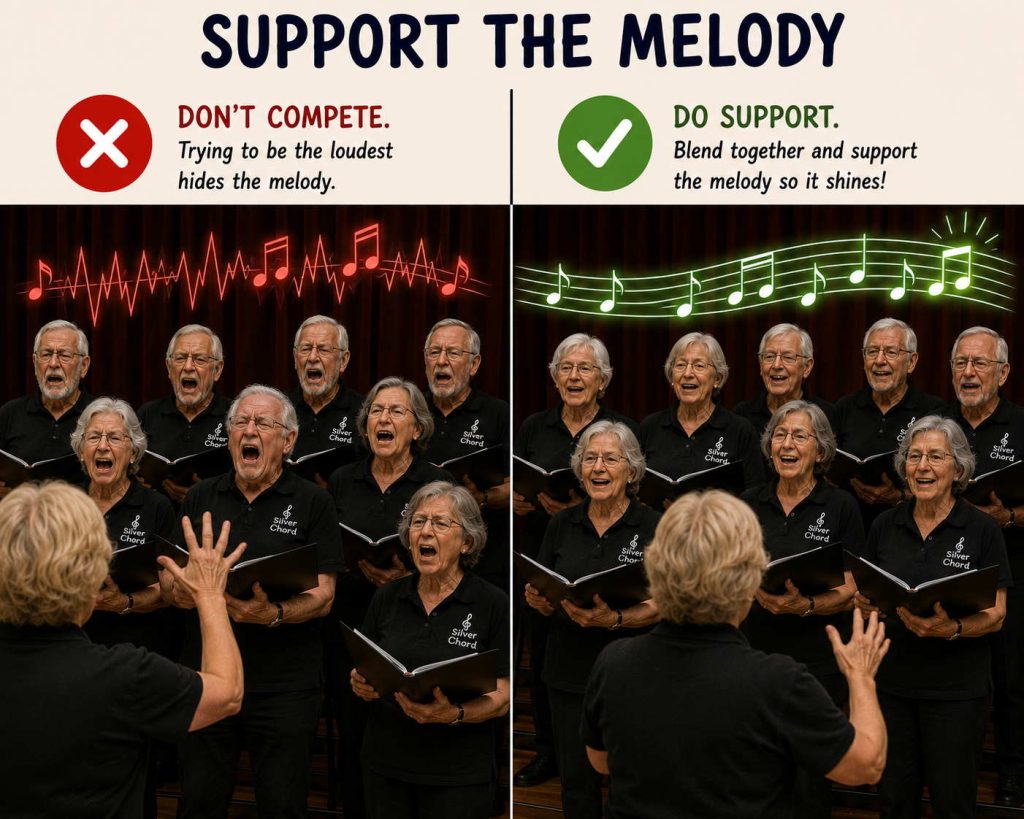 The song is carried by the melody. Harmony enriches the melody, and with some pieces the harmony is centre stage. In a choir like ours, where harmony doesn't often happen, we need to make sure the melody is clear and beautiful.
Singing loud can hide the melody and the ovrall sound of the choir. Listen to your neighbours and blend your loudness and tone with theirs so you build the melody and let it shine!
The song is carried by the melody. Harmony enriches the melody, and with some pieces the harmony is centre stage. In a choir like ours, where harmony doesn't often happen, we need to make sure the melody is clear and beautiful.
Singing loud can hide the melody and the ovrall sound of the choir. Listen to your neighbours and blend your loudness and tone with theirs so you build the melody and let it shine!
- Practice and Technique
Technique
is how you sing.It's doing warmups and exercises, learning how to sing different styles and so on.
Practice
is what you do at home - studying your music, learning the words, learning the melody.Rehearsal
is when you come together to sing as a choir, learn what your director wants and how to blend with everyone else.- Learn Your Music
Three things!
Get your music.
Either download and print it from this website (you'll need to login first) or get a copy at rehearsal.
Learn the words.
All of them. Learn the melody, but make sure you learn it correctly, not just how you think you remember it.
Practise your music.
Sing along to a recording. Some of our downloadable music has recordings you can sing along to, others you may have to learn at rehearsal. Once you know the song, you should no longer need your words in front of you. That means you can watch your director, and just as importantly, make eye contact with your audience!
Learning goes together with practice - so check out the next tip, Practise your music!
- Mark Your Music
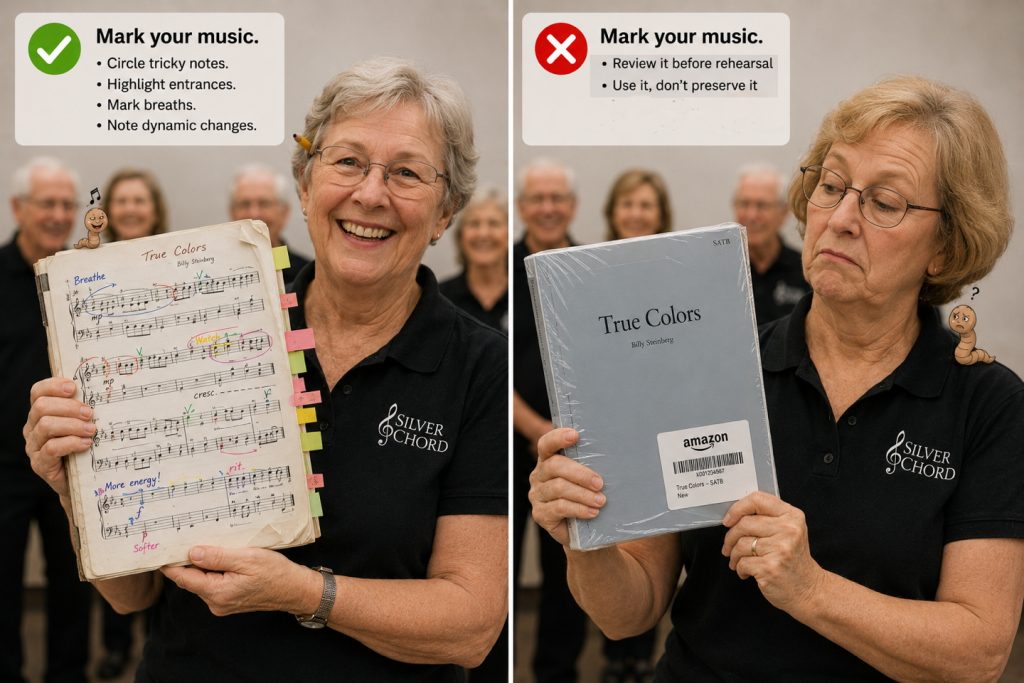
Music is meant to be used. Whether it's just a page of lyrics or full sheet music - is meant to be used.
Make notes on it! Highlight:
- breathing points
- style notes
- instructions from your director
- the parts you sing and the parts you don't
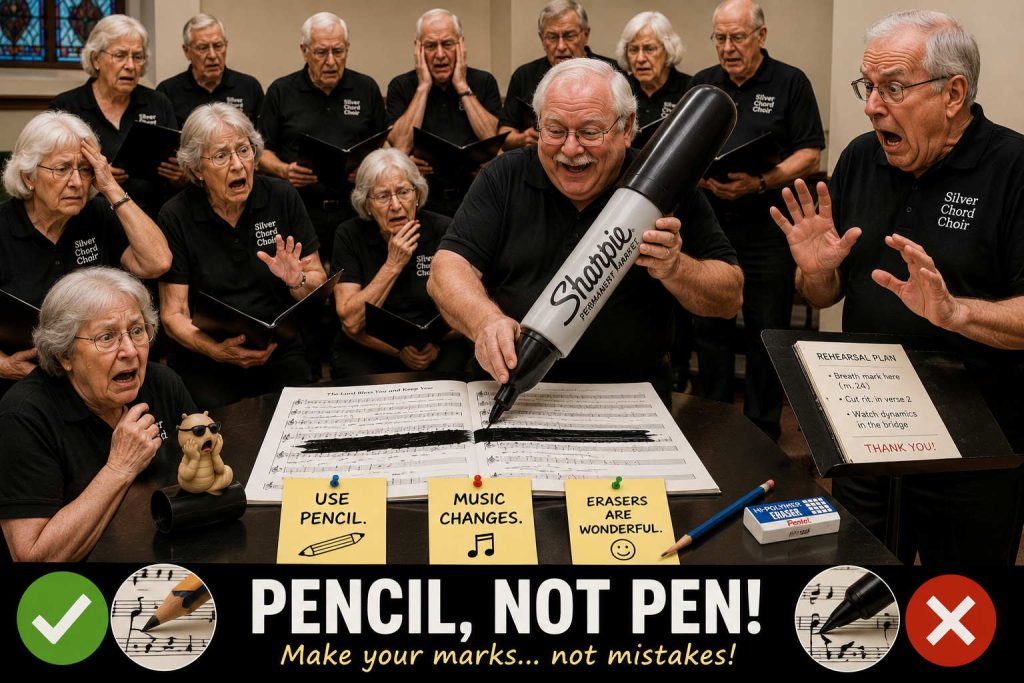
MARK IT IN PENCIL, not pen! Music - and your notes - have a habit of changing.
- Pencil, Not Pen
- Practise your music
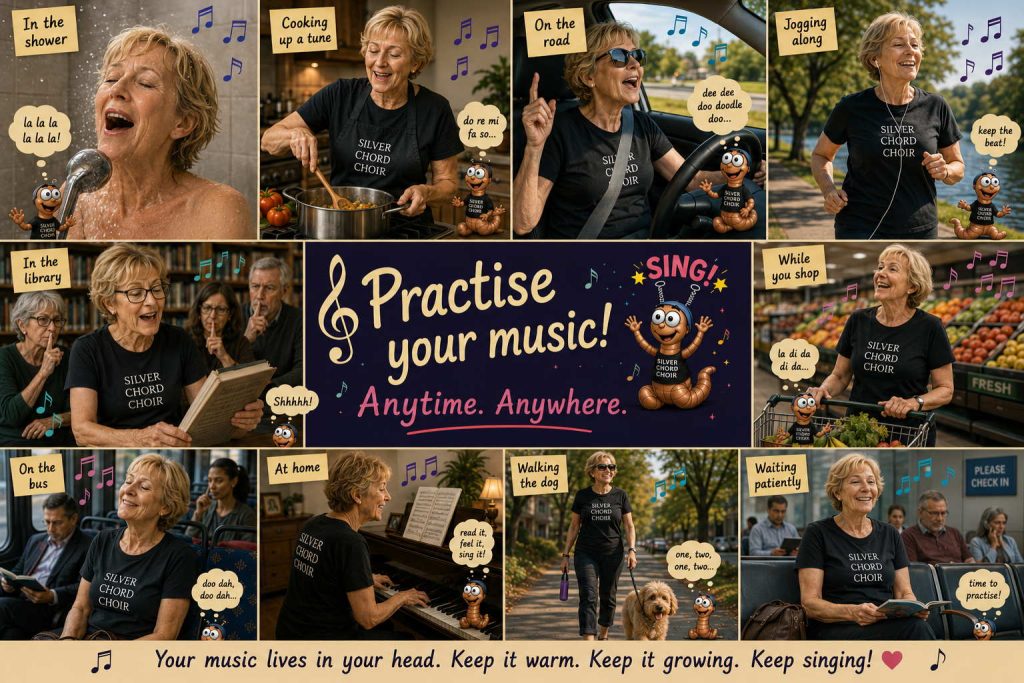
Learning and practising go hand in hand. Practice is something you do all the time, not just at rehearsals.
Sing a song over and over - in the shower, in the car, to yourself on the bus - wherever you can.
Practise singing without the words in front of you - the shower and the car are good places to enforce this! Learn a verse at a time. Once you know it, move on to the next - don't waste time repeating the parts you already know.
Record the song. If you have a portable recorder or if you know how to record on your phone, record the song during rehearsals, then practise at home with it.
When you come to rehearsal, you should have a good grip on the song and be ready to polish it with the rest of the group.
- Consonants Matter

This is a perennial choir issue.
Clear enunciation makes sure the audience can hear the words and follow the story the song is telling.Remember:
Vowels carry the sound.
Consonants carry the words.
Consonants must happen together - by everyone! Otherwise the song sounds ragged and unrehearsed.
Final consonants must happen together. Cut lines off together, so you don’t get a machine-gun effect.
- Vowels matter
Vowels
Warm up by singing through your vowels. It's a great way to focus your tone and energy before you start singing through your repertoire. Sometimes when we are tired or distracted, our tone can close up without us recognizing it, so taking a few moments to consciously focus your tone will result in a much more efficient practice. You can start on any note and move up or down by a half step as you go. Sing through the vowels “ae-ee-ah-oh-oo” and do your best to connect each vowel, not breathing until you move up to the next note.
- Tame the earworm!

Wait... what??
An earworm is a tune or a song that gets stuck in your head that you just can't get rid of. It hangs around, sometimes for days. It can be a commercial jingle (they're the worst) or something silly like The Muppets' "Ma-na Ma-na" song.
Sing your song to yourself enough that it becomes an earworm and gets stuck in your head. Just make sure you sing it right though - if your earworm learns the wrong tune it's very hard to change its mind!
When you find yourself walking down the street or washing dishes or getting ready for bed and humming and snapping your fingers to "Georgy Girl" or waltzing about to "Shall We Dance" - you've got an earworm!
- Learn some Terminology
 Terminology is simply language designed for a particular purpose.
Over the years, music has acquired a vast amount of specialised terms. You don't need to learn them all like our poor singer here, but knowing a handful of the basics makes it easier for your director to, well, direct, and for you to understand what's expected.
So here are the basics. You'll note that Italian is the language of music!
Volume:
- Piano - soft
- Forte - loud
- Mezzoforte - medium volume, where most of us tend to sing
- Fortissimo - maximum volume, without yelling
- Pianissimo - very soft, but not inaudible
- Crescendo - getting gradually louder - but not always to full volume. Watch your director!
- Decrescendo - getting gradually softer - but not always down to complete silence. Again, watch your director!
Style:
- Legato - a flowing style, with the notes seeming to connect together - but without actually sliding from one to the next, much as a violin would play them
- Staccato - short, sharp notes with actual breaks between them, much as a drum or xylophone would play them.
- Pizzicato - literally, "plucked", as a violinist plucks single strings. When singing, the notes and syllables are very short, but still sounded distinctly.
Tempo:
(to get a feel for this, find a metronome or download a metronome app; here's one. The settings are usually marked.)- Largo - extremely slow
- Andante - pretty slow
- Moderato - medium
- Allegro - brisk
- Allegretto - moving right along
- Presto - very fast indeed
- Prestissimo - insanely fast. This is Flight of the Bumblebee territory.
- Accelerando (usually written accel.) - getting gradually faster - watch your director
- Ritenudo (usually written rit.) - getting gradually slower - watch your director
- Ensemble Skills
- Listen Across the Choir
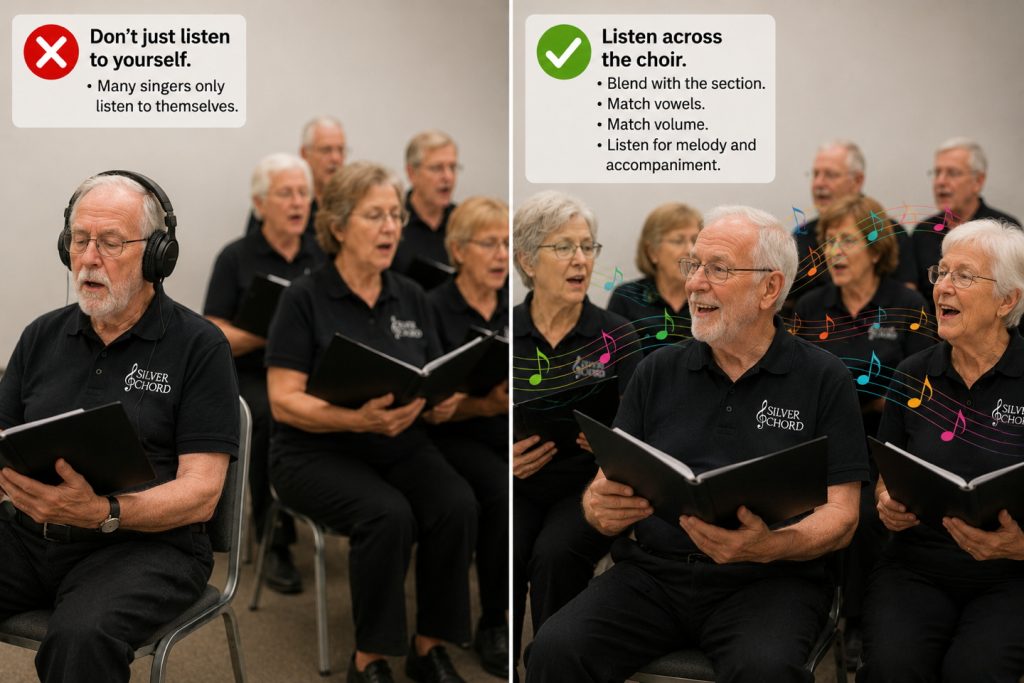
Many singers only listen to themselves.
Blend with your fellow singers.
Match your vowels.
Match your consonants - especially at line endings.
Match volume. Don’t drown out your fellow singers; keep the balance.
Match style. Flow a song or punch it as the song requires.
Listen for melody and accompaniment.
Follow your director!
- Watch the Cutoff
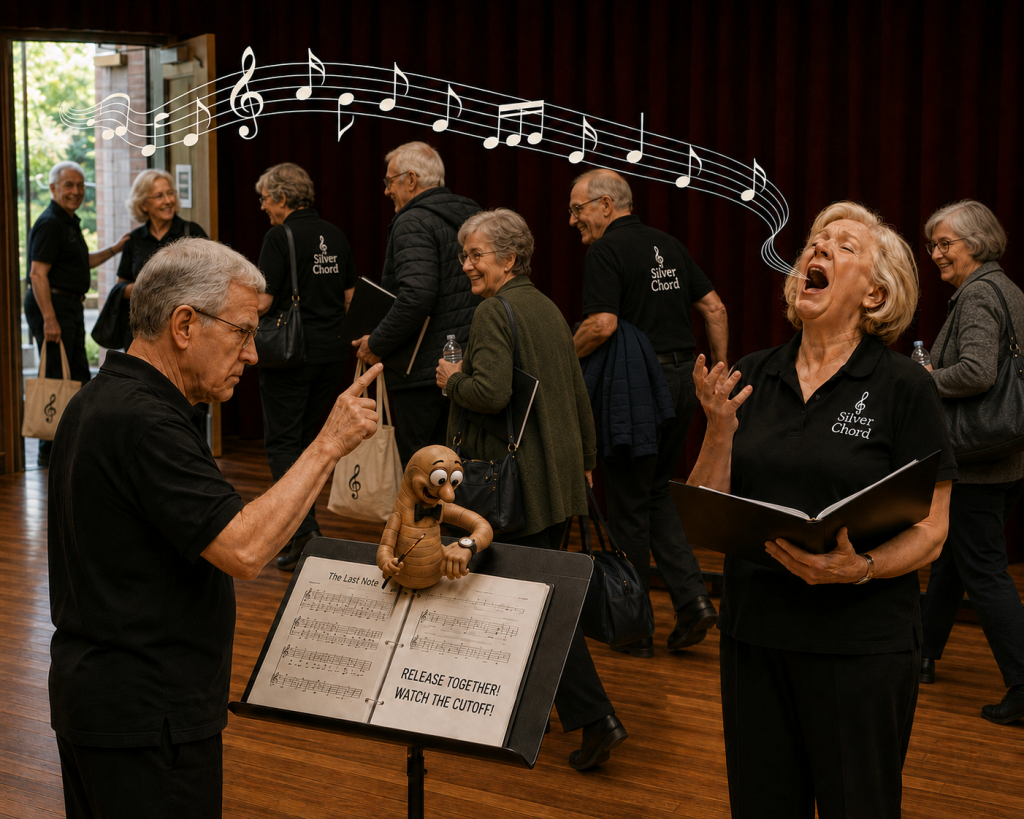
When the song ends, END IT.
Impromptu coloratura arias at the end of a song can easily spoil it. Follow your director meticulously.
- Count Your Rests
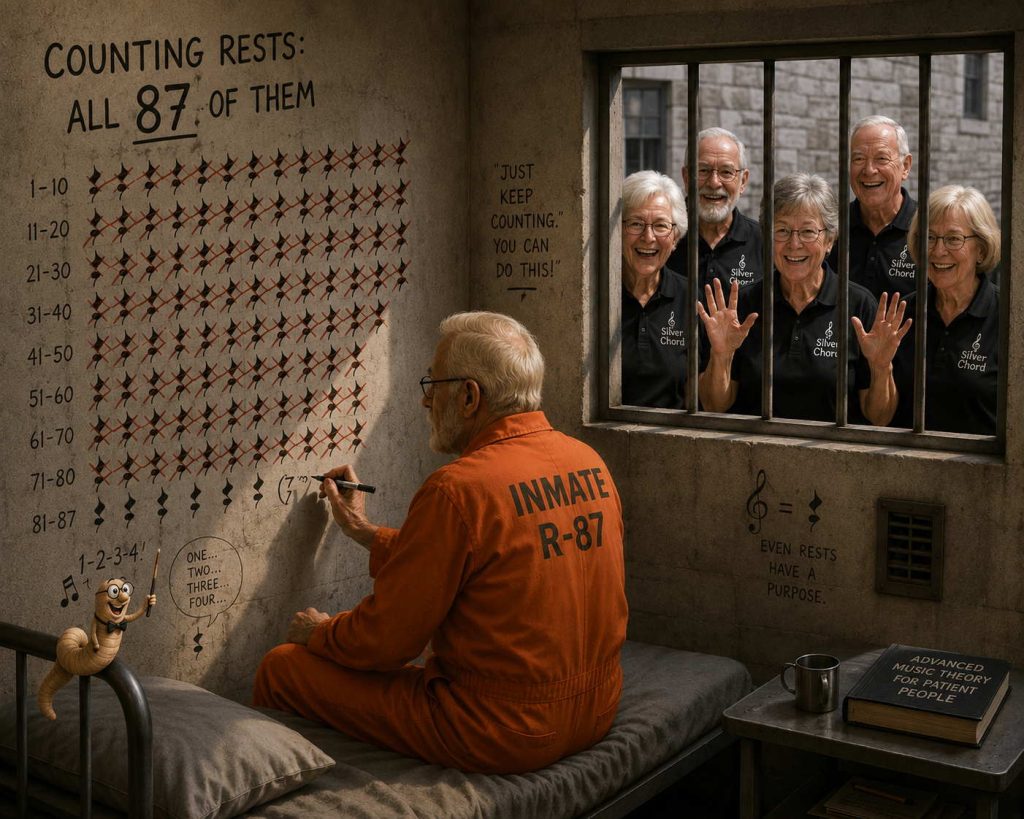
Rests are the silent spaces in music.
They may be only one or two beats long.
They can be an entire line, or even an entire verse.
Men may have a one- or two word rest whie the women sing, and vice versa.
Yes, if you have 87 beats of rests, you must wait them ALL out!
- Breathe Together
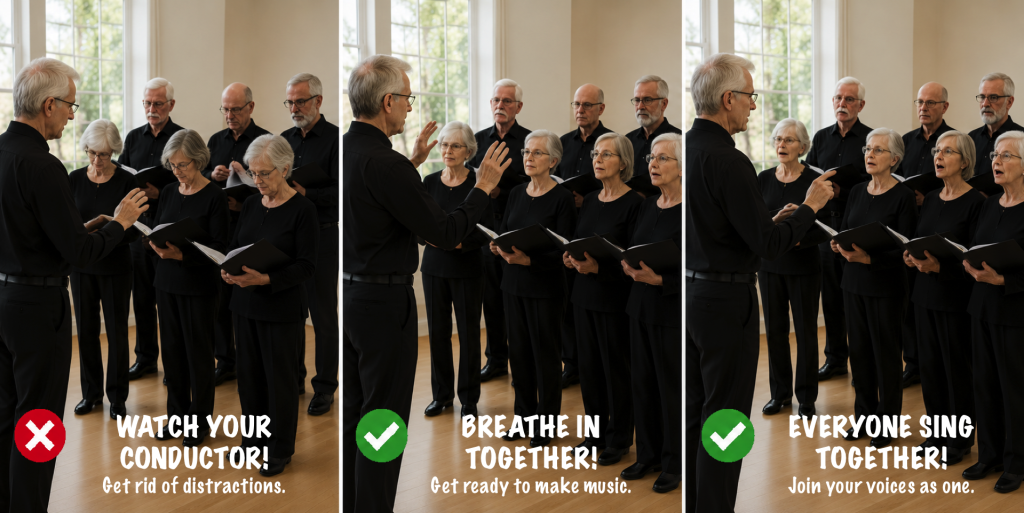
Breathe together
Watch your conductor. You'll be given an upbeat; get prepared.
Breathe in together. Get your voice ready for that first note, so you don't all sound ragged and unprepared.
Sing that first note all together on your conductor's downbeat. Don't wait for your neighbour to sing first.
- Turn Pages Early
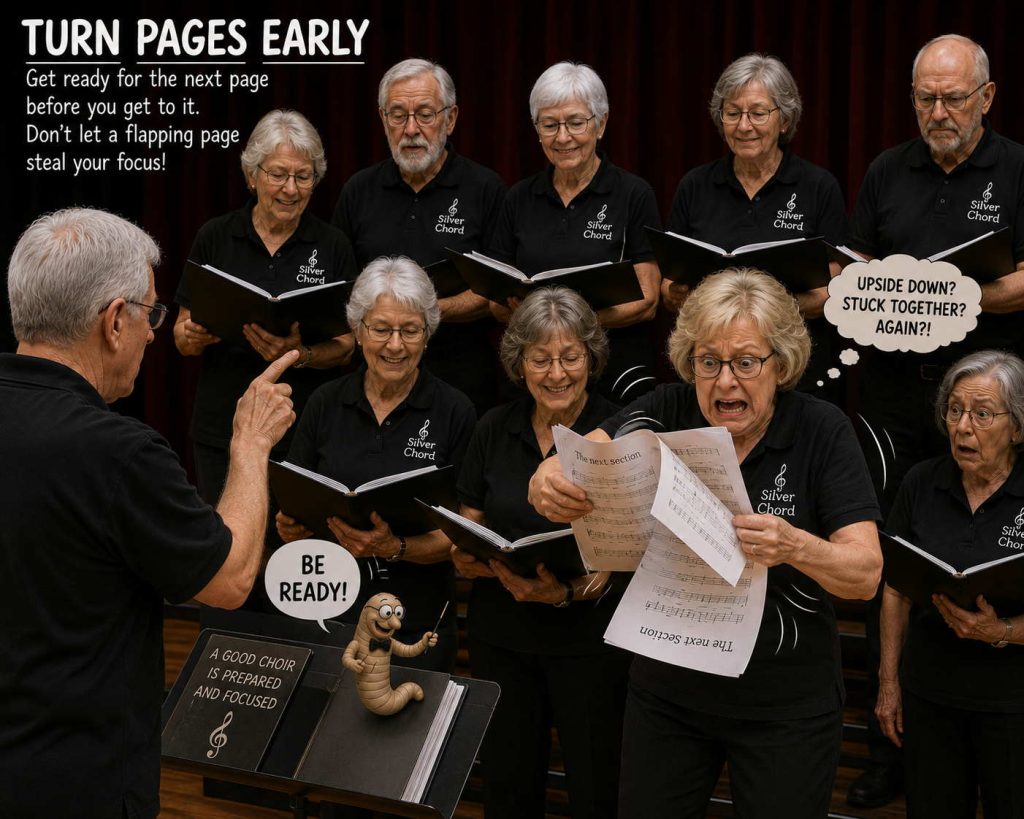
Most of Silver Chord’s music is on a single page, but check if there’s more than one.
Be ready to turn the page by the end of the last verse.
Turn the page before you sing the last line.
During a show, have all your music in order before you go on stage,
- Rejoin Quietly
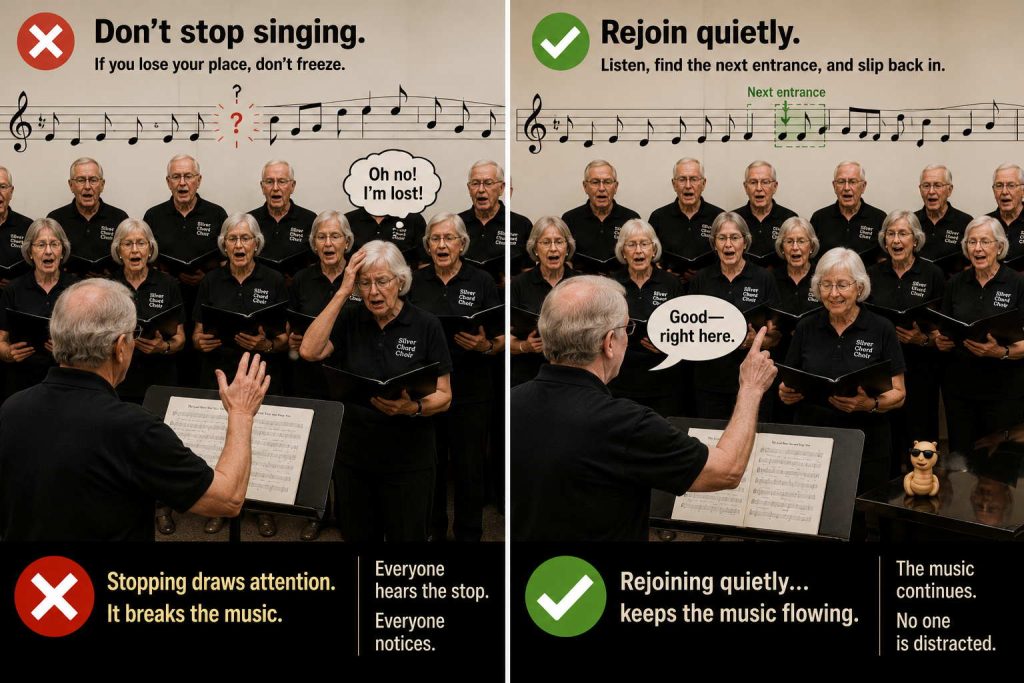
Distracted? Lose your place? It happens to us all.
Look ahead to the next line or verse. Join in there.
- Rehearsal Habits
- Follow Your Director
Your director is not a boot-camp sergeant
... but his or her directions are vital to making a song musical and coherent. Your director will guide you in- dynamics (the loudness or softness of a piece)
- mood (the overall sound of a piece)
- entrances at the beginning of a piece or tricky line starts
- endings (or cutoffs) of lines or verses
- breaks for instrumental verses
- and much more.
- Watch Your Director
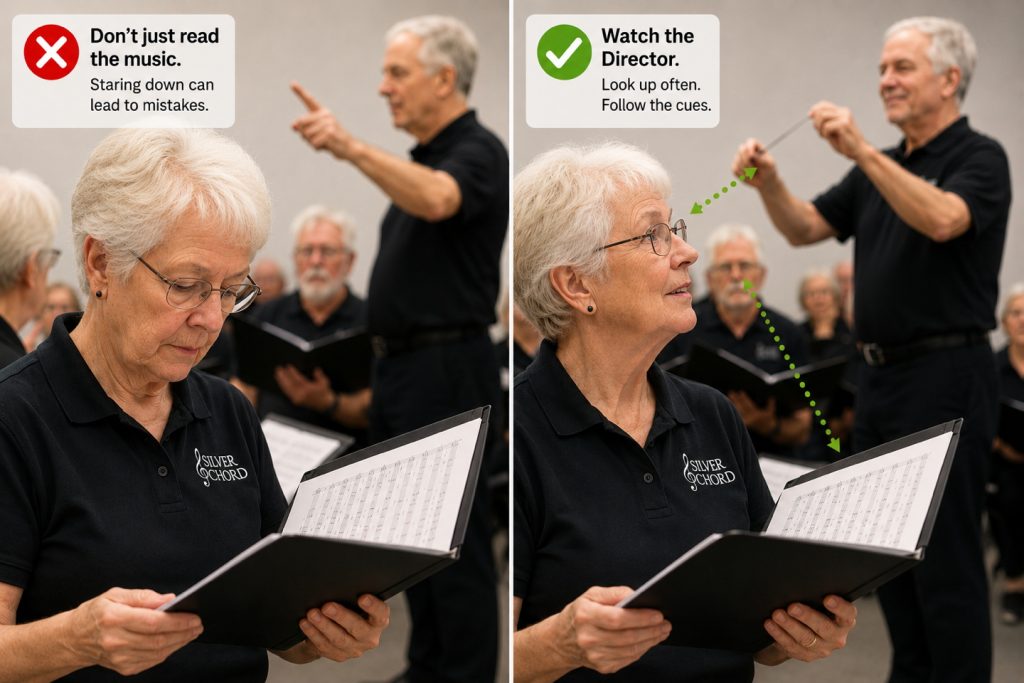 Watch more than you think you need to.
The director gives tempo, dynamics, cutoffs, entries and expression.
Looking up for even half a second can prevent a mistake.
- About Dynamics

Dynamics are more than just loudness and softness.
Dynamics make the mood of a song. Is it punchy and animated or smooth and mellow?
Dynamics affect the balance between parts. Do the men have a soft "oo" underneath the women's parts or does the men's part dominate with the women singing softly behind them? Or does the song require an even balance of parts to make the harmony shine?
Dynamics are always under your director's control; this is why it's essential to watch for directions.
So, how do you accomplish dynamics?
Singing louder never, EVER means yelling. You must remain on pitch at all times, even when singing full voice. Think of increasing your breath pressure, not forcing more air over your vocal chords. Forcing more air means you'll run out of breath faster. Focusing on breath pressure lets you sustain even a loud note for a surprisingly long time.
Singing softer never means going breathy. You must still remain on pitch, even when your entire section is singing so softly you can barely hear your own voice. Reduce your breath pressure; don't cheat by letting air bleed past your vocal chords. Good breath pressure keeps your tone clear and clean.
There's a whole range of dynamics between loud and soft. For example, "Do You Hear the People Sing" starts out very soft, like a crowd in the distance. As they march towards you it gradually gets louder and louder until your audience is immersed in the triumphant energy of the last chorus. There's no sudden switch from soft to loud.
- About Mood
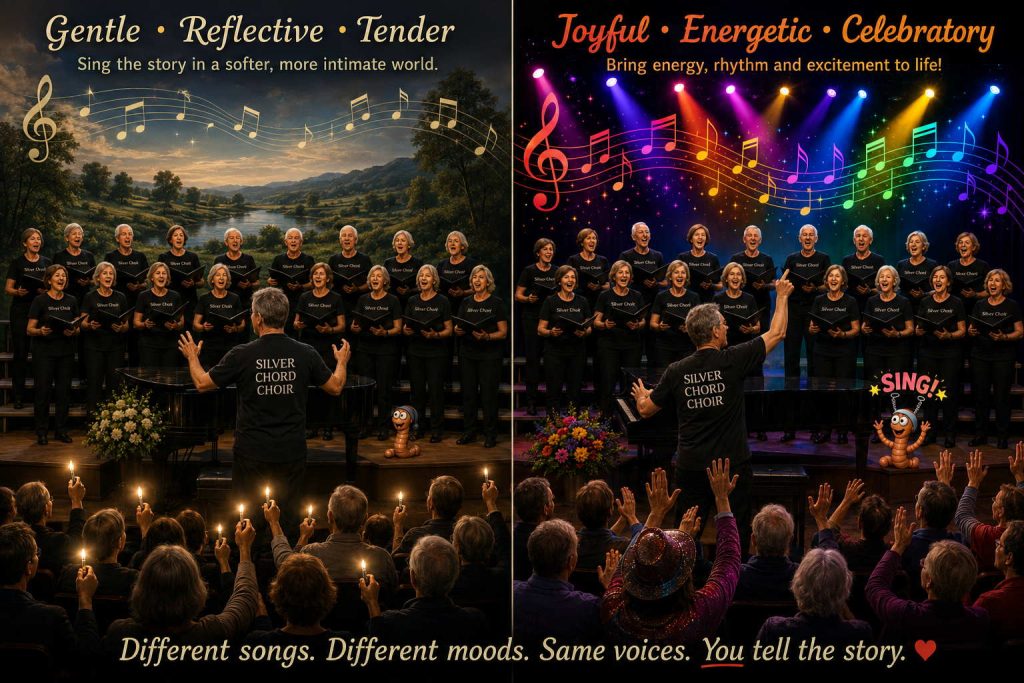
The mood of a song is how it tells its story. Your role as a singer is to put a voice to that story, to lift it off the paper and give it life. You are the one who gives that song a place in your audience's heart.
Listen to the song. Does it make you feel happy? angry? light-hearted? wistful? lonely? grieving? hopeful? uplifted?
Now study what it is that evokes those feelings. Is the song quick and rhythmic, with a strong beat to carry it along? Is it slower, with more of a focus on lovely flowing melody? Is it in a minor (sadder-sounding) key or a major key? Does it switch from one to the other to reflect a change in the song?
Next, how do you sing a strong beat? Most of us think of a march, but most dance tunes have an easily followed rhythm. Short, snappy notes will liven up any song, whereas longer, flowing (legato) notes will smooth out the rhythm and change it more to a ballad.
Flowing, legato pieces have some challenges. Breath control is all-important, so you can sustain passages without interruption. Dynamics are vital, to maintain interest and to help convey the mood. Occasionally the tempo may change slightly as you pass from one phrase or thought to another.
Follow your director meticulously.
- Confidence vs. Volume
- Performance and Concert Day
- We sing together for many reasons. One of the important ones is to entertain. We have many kinds of audience:
- care homes
- community events
- special occasions
- Arrive Prepared
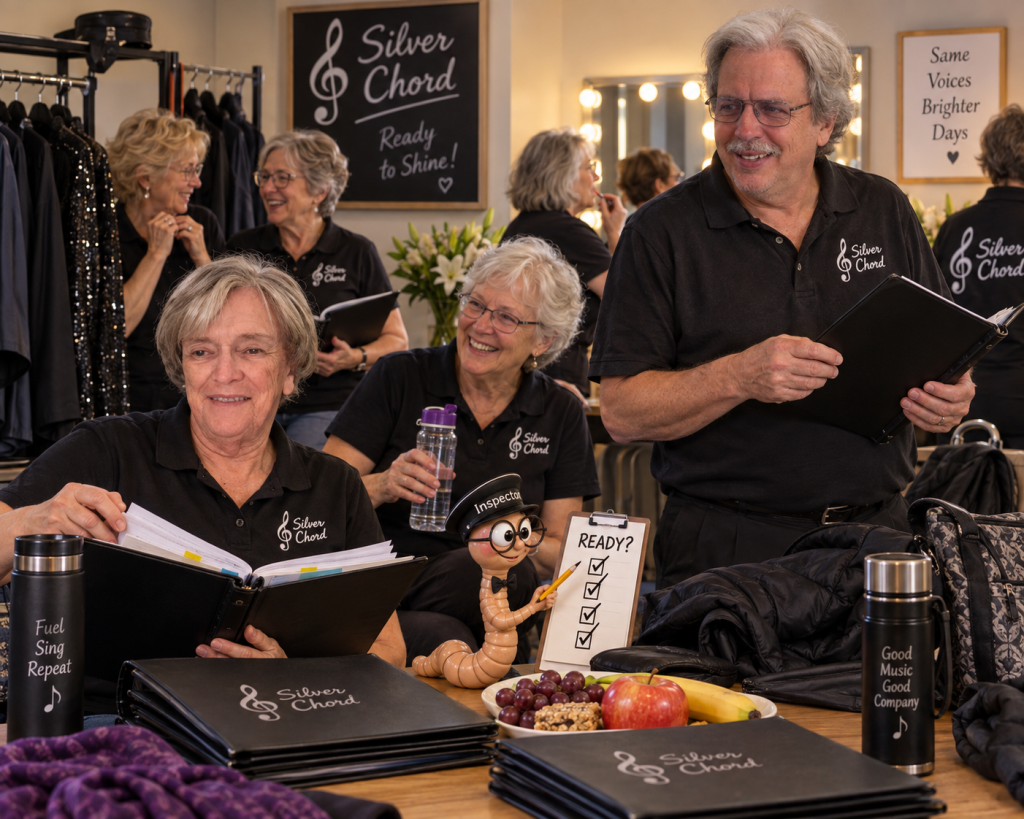
Be prepared for the show!
Here's a checklist.- Get your music in order.
- Have something light to eat.
- Find out the dress code. Formal? Casual? Something else?
- Know where you're going!
- Arrange a ride or carpool.
- Arrive early. Be there half an hour before showtime, longer if you're helping set up.
- Help with Setup and Teardown
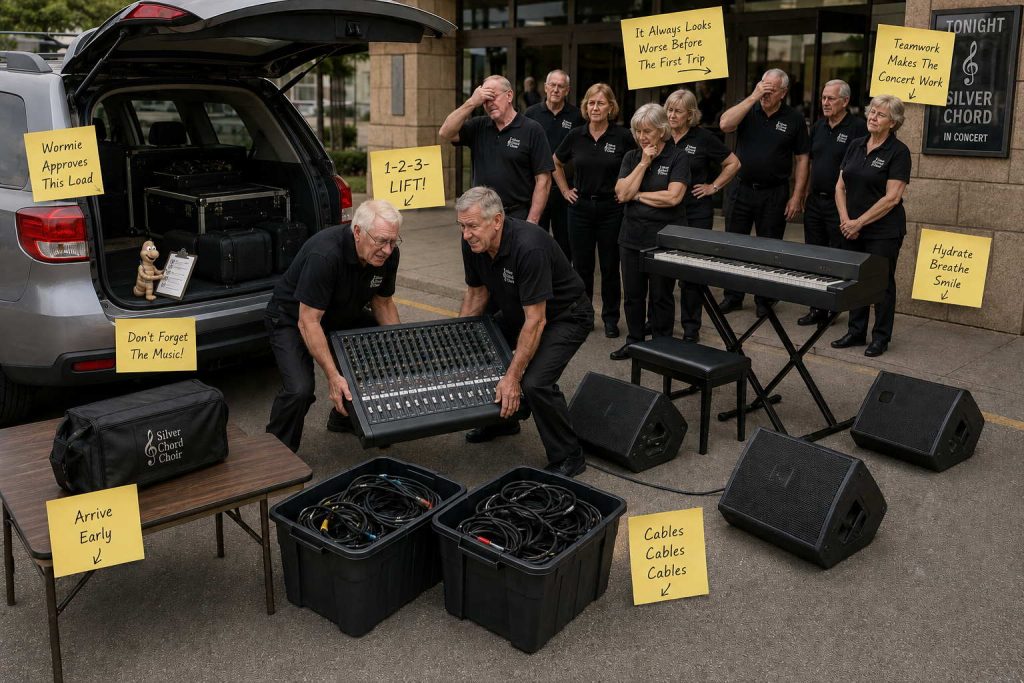
Many of our show venues have a good piano that’s acceptably in tune. For others, we must bring our own keyboard and speakers. For those shows, we ask that a few singers arrive about 15 minutes early to help unload the equipment into the venue and stay afterwards to help move it back out.
Okay, we rarely have as much gear as this, but you get the idea!
- Have your Music Ready
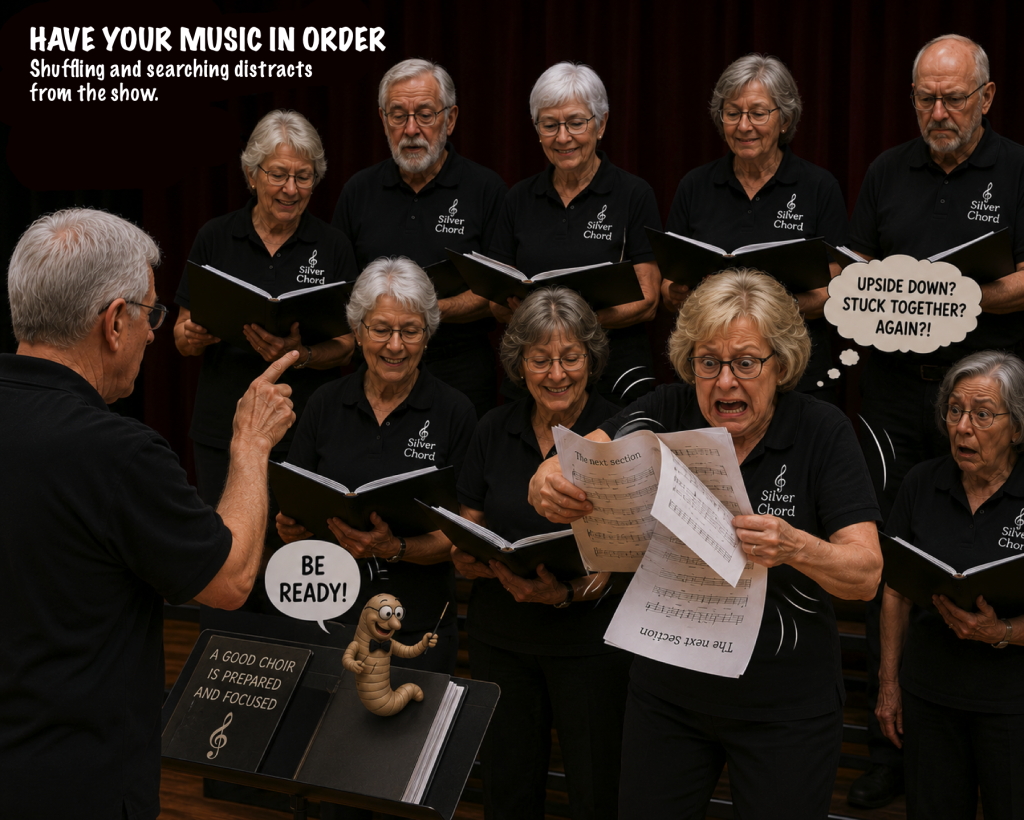
Put your music in order before you go on stage.
Put only the music for the show in your folder.
A tiny fold or "dog-ear" at the top of each page makes it easier to turn.
- Silence Your Phone
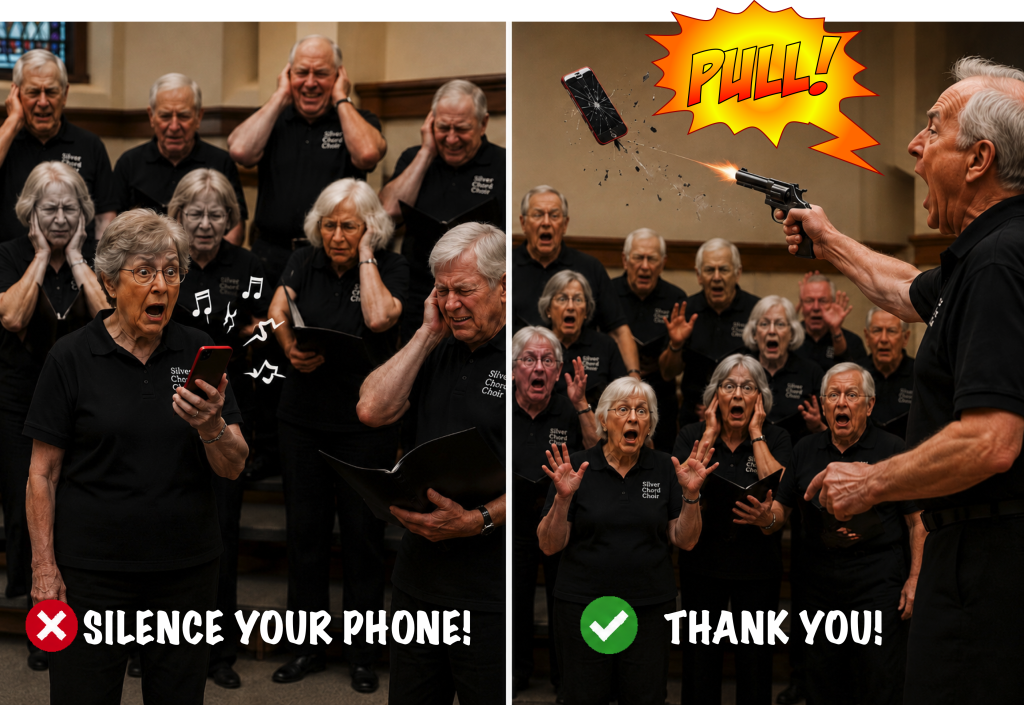
Enough said.
- Engage your audience

This is why people come to see you. They come to be entertained. To entertain means, obviously, to be entertaining.
Nothing is more engaging than eye contact. It's a fundamental thing about people. It establishes sincerity, interest and trust. So next time you perform, pick someone in the audience and sing your song to them. Some examples:
- Ask them, personally and sincerely, "Shall we Dance?" Make it feel like an actual invitation.
- Look them in the eye and try to make them believe that no matter how badly you slipped up, "You Were Always on My Mind".
- In "Yesterday" you open your heart and your hurt and your longing. Make them believe that you chose just them to share that with.
- If it's a happy song, put that smile on your face and that twinkle in your eye as you romp through "Mairi's Wedding".
- Pick someone else for the next verse or the next song.